
HOMEOWNER GUIDES · COSTS & BUDGETING
Why Are Building Costs So High Right Now?
Material and labour costs explained — and how to make sense of your next quote.
By Sam Winder · Co-founder of Clearly Built
Practical construction advice to help homeowners understand quotes, plan work and make confident decisions.
19 October 2026 · 5 min read
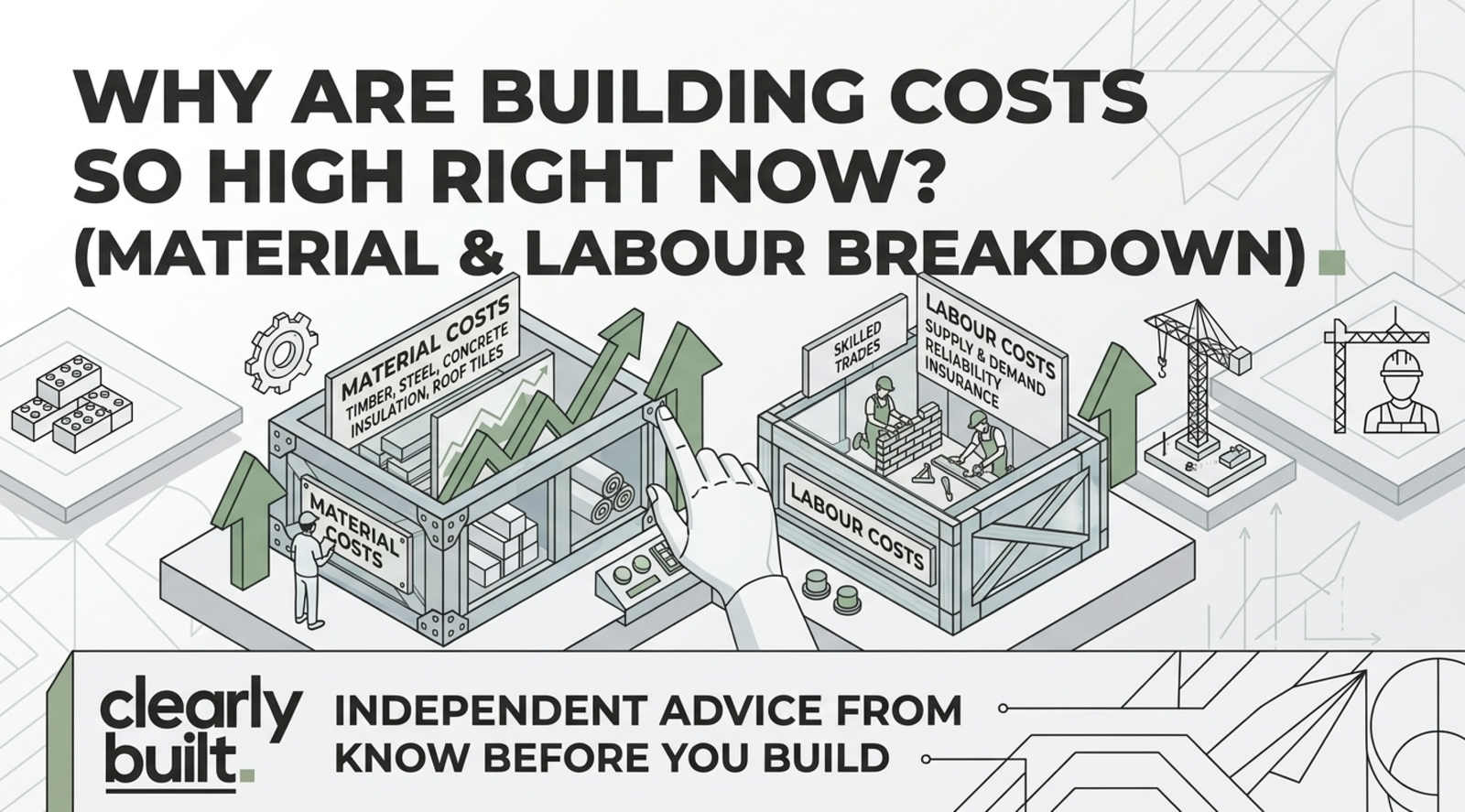
If you’ve received a builder’s quote recently, you may have experienced a little sticker shock. A project you priced a few years ago can look very different today, leaving you wondering: Is this normal, or am I being overcharged?
The answer is rarely in the total alone. Materials, labour, access, specifications and the cost of running a business all influence the price. Wider market pressures can help explain a high quote, but they do not prove that every quote is fair.
At Clearly Built, we help homeowners understand what they are paying for before committing. Here are the main cost drivers — and what you can do about them.
1. Materials: slower inflation doesn’t mean lower prices
It helps to separate the price level from the rate of change. If a material rises sharply and then stops rising, it stays expensive compared with its earlier price. “Inflation has eased” does not mean the price has returned to where it started.
Timber, steel, concrete products, insulation and glazing have different supply chains. Energy, manufacturing, transport, imports and exchange rates can affect them differently. One product may fall in price while another rises, so it would be misleading to say every material is currently at an all-time high.
The government’s Building Materials and Components statistics track selected material price indices and production data. They provide useful market context, rather than a price list for your particular job.
What to ask: Which products, quantities and finishes are included? Does the price cover delivery, wastage and fixings? How long are supplier prices valid? Compare the same specification, not simply “timber” or “tiles”.
2. Skilled labour: availability is local
Construction relies on people with practical skills and experience. When the trades needed for your project are in short supply locally, finding a suitable team can take longer and labour rates can face upward pressure.
CITB’s Construction Workforce Outlook 2026–2030 estimates that an average of 41,200 additional workers a year will be needed over that period to meet forecast demand and replace people leaving the industry. This is a forecast of recruitment needs, not a count of currently unfilled jobs.
Conditions vary by region, occupation and project type. Not every builder has a full order book, and a national skills forecast cannot tell you what a local day rate should be.
A higher rate does not guarantee reliability or workmanship. Check relevant experience, recent references, insurance and how the builder explains the job. Also compare the estimated time and team size: the lowest day rate does not necessarily produce the lowest total labour cost.
Comparing quotes? Our guide to How to Check if a Builder’s Quote is Fair (UK Guide) explains how to compare the scope, spot missing costs and ask the right questions before you commit.
3. You’re also paying for the business behind the work
A builder’s price needs to cover more than wages and a merchant’s invoice. Running a viable business involves costs that may not appear as separate lines:
- Vans, fuel, maintenance, tools and equipment.
- Insurance, administration, estimating and bookkeeping.
- Training, supervision, safety arrangements and relevant compliance work.
- Employment costs where staff are employed, and time that cannot be billed directly to a customer.
- A reasonable profit and an allowance for the risks the builder is taking under the agreed contract.
These costs can change over time, but it is too simplistic to claim they all rise together. Overheads and profit are legitimate parts of a quote. The useful question is whether the total makes sense for the agreed work and the level of service being provided.
4. The same finished result can require very different work
Two patios of the same size may have different prices because one site has easy access and firm ground, while the other requires hand-carrying materials, removing old concrete and resolving drainage.
The same applies to extensions, garden rooms and renovations. Excavation, temporary supports, protection of existing finishes, waste disposal, specialist input and restricted working space can add time and cost before the visible work begins.
Ask the builder to explain the main cost drivers on your site. A clear explanation is more useful than comparing your total with a neighbour’s project that had different conditions.
What your quote actually pays for
- Materials: the products, quantities, delivery and relevant wastage.
- Labour: the team, specialist skills and time required.
- Site costs: plant hire, scaffolding, protection, skips and access arrangements.
- Business costs and margin: overheads, management, risk and profit.
- Tax: VAT where applicable; confirm whether it is included.
There is no universal “correct” percentage split. A labour-intensive repair will look different from a project using expensive bespoke products. Ask for enough detail to understand the price without expecting every builder to present their accounts in the same way.
How to protect your budget
- Compare like for like. Give builders the same scope, dimensions and specification. A lump-sum quote can be valid if the included work is clear; an itemised breakdown makes differences easier to understand.
- Resolve allowances early. A PC (Prime Cost) sum usually allows for an item you have not selected. A provisional sum allows for work not yet fully defined. Check the quote’s definitions, inclusions and adjustment terms.
- Separate essentials from preferences. Ask about alternative finishes, standard sizes or a simpler layout. Don’t cut structural, drainage or safety requirements to make the total fit.
- Plan changes before work starts. Late changes can mean wasted materials, repeat visits and delays. Record the cost and timing of changes before agreeing to them.
- Keep a project-specific contingency. Discuss uncertainty with the builder or adviser. An older property or unclear ground conditions may need more headroom than a well-defined job.
- Check the exclusions. Waste removal, making good, approvals and specialist fees can change the real amount you need to budget.
For a practical checklist, read our guide: How to check if a builder’s quote is fair.
CLARITY BEFORE COMMITMENT
High quote? Understand it before you commit.
Clearly Built can help you review the scope, identify unclear allowances and explore sensible options for your budget. Get an independent second opinion and a clear list of questions to take back to your builder.
Start with a free 20-minute conversation. Tell us about your project and what concerns you. We’ll explain the support available and any review fee before you decide.
No obligation. Clear next steps. Your decision.